
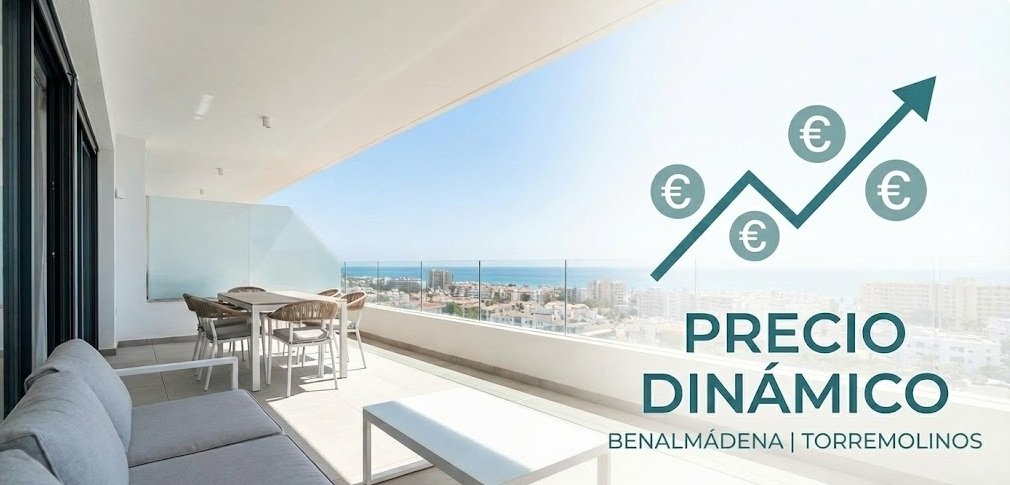
If you are a property owner, you have surely asked yourself this: “Why is my apartment fully booked some weeks while others remain empty, even though I set a ‘reasonable price’?” In areas like Torremolinos and Benalmádena, where demand fluctuates heavily based on seasons, events, and days of the week, the difference between using a “fixed price” and applying dynamic pricing can be massive.
In this article, I will explain—without the technical jargon—how dynamic pricing works and what we do to balance occupancy and income without “crashing” your rates.
What is Dynamic Pricing in Vacation Rentals?
Dynamic pricing is a method of setting nightly rates that adjusts continuously based on real market demand. Instead of having a “flat” price (for example, €120/night all summer), the rate changes depending on:
- Seasonality (High, medium, and low seasons).
- Day of the week (Fridays and Saturdays usually command higher rates).
- Booking lead time (Last-minute vs. bookings made months in advance).
- Events (Local fairs, conferences, holidays).
- Competition (Similar apartments in your specific area).
- Listing performance (Conversion rates, reviews, and content quality).
The goal isn’t just to “increase prices,” but to sell every night at the best possible price.
Why Fixed Prices Often Fail in Torremolinos and Benalmádena
- Demand changes fast: The Costa del Sol has very sharp peaks and valleys. A fixed price means you are often too cheap when you could be earning more, or too expensive when you need to fill gaps.
- Instant comparisons: Guests see dozens of options in seconds. If your price doesn’t “fit” what your property offers (location, views, pool, parking, condition, reviews), you lose clicks and bookings.
- Micro-zones behave differently: Playamar, La Carihuela, Bajondillo, or Puerto Marina do not all follow the same trends. Dynamic pricing works best when tailored to: Zone + Property Type + Real Demand.
The 6 Key Factors Influencing Dynamic Prices
- Market Seasonality and Occupancy: It’s not just “summer vs. winter.” Specific weeks have high demand pressure that requires a unique strategy.
- Weekdays and Minimum Stay: A weekend can be worth significantly more than three weeknights. Adjusting minimum stays prevents losing high-value opportunities.
- Booking Lead Time: If there is a long window left, we work with a “target price.” If the date is approaching, we activate a “smart filling” strategy.
- Local Events and Calendar: During local festivals or events, demand skyrockets. Dynamic pricing ensures you don’t leave money on the table.
- Your Real Competition: You aren’t competing against “every flat”; you compete against properties similar in quality, location, and reputation.
- Listing Quality: Professional photos, titles, descriptions, and amenities—and above all, reviews—affect your conversion rate. A better listing converts more and allows for higher rates.
Common Dynamic Pricing Mistakes (and How to Avoid Them)
- Error 1: Dropping prices too much to “fill up”: This often attracts the type of guest that causes more issues and lowers overall profitability. It’s better to adjust gradually and with clear criteria.
- Error 2: Not differentiating weekends from weekdays: Setting the same price means losing money on peak days or staying empty during the quiet ones.
- Error 3: Ignoring listing performance: If your listing doesn’t convert, the algorithm penalizes you. First, fix the “product” (content and experience), then the price.
- Error 4: Poor calendar management: Sometimes the issue isn’t the price; it’s a misconfigured calendar (wrong minimum stays, gaps, or restrictions).
A Simple Example
Imagine your property has a target average price of €120/night.
- If demand rises during a specific week (more searches, less supply), dynamic pricing might move to €140–€160/night.
- During a quieter week, it might adjust to €105–€115/night to maintain occupancy without “tanking” the value.
- The result is usually higher annual income without always having to be the “cheapest” option.
How We Apply This at IVI Real Estate
In our vacation rental management, dynamic pricing isn’t a standalone tool; it rests on three pillars:
- Pricing & Calendar Strategy (Minimums, gaps, timing).
- Listing Optimization (Content that converts).
- Operations & Reputation (Cleaning, check-in/out, and high-quality reviews).
Even the best pricing strategy won’t work if the listing doesn’t convert or if poor experiences lead to low ratings.
Quick Questions from Owners
- Does dynamic pricing mean changing prices every single day? Not necessarily “every day,” but adjusting whenever the market requires it. Consistency and control are key.
- Can I use this if I stay in my property for some weeks? Yes. We plan the calendar with your blocked dates and optimize the remaining ones to maximize profit.
- Does it work the same in Torremolinos and Benalmádena? The foundation is the same, but the specific adjustments change based on the zone and guest profile.